Lawyer for trademark law – registration, conflicts & enforcement
For companies with their own brands – registration, monitoring, opposition and enforcement against infringers. Your trademark lawyer at ITMR supports the registration of your trademarks, conflicts and enforcement.
Trademark law for companies: registration, Abmahnung, enforcement
ITMR Rechtsanwälte advises companies throughout Germany on trademark law. We help when you want to register a name, a logo or a claim, have received an Abmahnung (formal warning letter) or want to stop a trademark infringement.
We advise companies, start-ups, agencies, e-commerce providers, brand managers and other professional market participants. Our aim is to resolve conflicts with earlier trademarks before they block a launch, distribution or advertising budget.
Responsible for content: Jean Paul P. Bohne, Fachanwalt für IT-Recht (certified specialist lawyer for IT law), Fachanwalt für Urheber- und Medienrecht (certified specialist lawyer for copyright and media law), AI Officer (DEKRA), reviewed on 23 October 2026 (German version)
What is your situation?
Register a trademark
A product name, a rebranding, a claim or a logo is about to go to market. Beforehand, we check whether the sign is capable of protection, which classes fit and whether earlier trademarks stand in the way.
Received an Abmahnung (formal warning letter)?
You have received an Abmahnung under trademark law or your application is being challenged. We check deadlines, use and claims and respond to the letter in a way that fits legally and commercially.
Pursue a trademark infringement
Your trademark is being used or deliberately exploited in listings, domains, search ads, product feeds or reseller structures. This can infringe the trademark's function as an indication of origin. We secure evidence and choose between a platform report, an Abmahnung and court proceedings.
Trademark portfolio and monitoring
Several signs, product lines or markets need a clear structure. We take care of monitoring, extension, renewal and licensing and support your trademarks in ongoing business.
Trademark lawsuit received
A lawsuit or an einstweilige Verfügung (preliminary injunction) concerning a trademark has been served: we secure deadlines, examine claims for injunctive relief and information and defend your company.
Opposition against your trademark
An opposition (Widerspruch) has been filed against your new trademark: we examine the strength of the attack, use and the scope for a limitation or settlement.
This page gives an overview from strategy through conflicts to enforcement. Is your sign already fixed and is the focus mainly on searches, classes, the list of goods and services and filing? Then Register a trademark is the right next step. Before a launch or rebranding, the check for new trademarks helps.
In brief
We support trademarks from registration to enforcement. First, we clarify whether the sign is capable of protection and whether earlier trademarks stand in the way. In conflicts, deadlines and evidence are what count.
Responsible lawyers for trademark law

Your contact: Jean Paul P. Bohne
Fachanwalt für IT-Recht · Fachanwalt für Urheber- und Medienrecht (certified specialist lawyer for IT law · for copyright and media law)
What happens after your enquiry?
After your enquiry, we get back to you within 24 hours on working days. The first contact is free of charge. Before any costs arise, we tell you so explicitly.
- A short description is enough. Helpful are the sign as a word or image, the planned goods and services and the target markets. In the event of conflicts, please send us the other side's letter, screenshots and any running deadlines.
- Receipt and initial sorting. We assess the enquiry on the basis of the project described, the documents and the apparent goal. Deadlines and dates should be clearly recognisable.
- Suitable starting point and cost range. We clarify whether an initial consultation, a service package or a specific mandate is the next step. As soon as the scope of the review is clear, we tell you the cost range – before work begins.
Your contact is Jean Paul P. Bohne and his team. He is a Fachanwalt für IT-Recht (certified specialist lawyer for IT law) and a Fachanwalt für Urheber- und Medienrecht (certified specialist lawyer for copyright and media law).
Trademark mandates frequently touch on the law of distinctive signs, digital distribution, contracts and contentious enforcement. What matters are relevant areas of practice and the experience of bringing trademark registration and conflict work together.
Jean Paul P. Bohne, LL.M., MM
Partner. Fachanwalt für Informationstechnologierecht (certified specialist lawyer for IT law) and Fachanwalt für Urheber- und Medienrecht (certified specialist lawyer for copyright and media law). Particularly relevant in mandates in which trademark law converges with digital business models, platform distribution, contracts and contentious enforcement.
- Fachanwalt für Urheber- und Medienrecht (copyright and media law)
- Fachanwalt für IT-Recht (IT law)
Further qualifications: AI Officer and KI-Beauftragter (AI officer, DEKRA), CIPP/E, CIPM, external data protection officer, data protection auditor and IT compliance manager (TÜV).
T: +49 211 737547-70 · E: bohne@itmr-legal.de
 Rechtsanwältin (attorney) · employed
Emma-Marie Kürsch
Rechtsanwältin (attorney) focusing on trademark law, copyright law and IT law. In addition, questions of intellectual property, design law, domain law, licensing, advertising law and competition law.
- For companies and professional market participants
- Advice from trademark registration through opposition and Abmahnung to contentious enforcement
- Focus on launch, distribution, platforms, domains, portfolio and conflict cases
Typical cases from our trademark law practice
We regularly encounter the following constellations in our advisory work. They are abstracted and simplified. Often it is decided even before registration whether a trademark project will hold up later. Every review depends on the sign, the register and the objective in the individual case.
LaunchConflict shortly before product launch
- Starting point
- A start-up wants to introduce a new product name in Germany and the EU. Packaging and campaign are already planned.
- Key difficulty
- The search reveals an earlier, similar trademark for related goods. The DPMA (German Patent and Trade Mark Office) does not examine such earlier rights of its own motion during registration.
- Our work
- We assess similarity of the signs, proximity of the goods and distinctiveness. We then compare options such as adapting the sign, a narrower list of goods and services or a coexistence arrangement with the owner.
- Work result
- Memo on the risk of conflict, recommendation on the target countries and a coordinated list of goods and services.
Simplified example.
PlatformTrademark infringement in Amazon listings
- Starting point
- A seller offers imitations under our client's trademark and attaches itself to existing listings.
- Key difficulty
- It is open whether there is use as a trademark and which route works quickly. Options are the platform process, an Abmahnung or an einstweilige Verfügung (preliminary injunction).
- Our work
- We secure screenshots, test purchases and seller data and examine the claims under Section 14 MarkenG. We then choose the next step according to impact and effort.
- Work result
- Evidence dossier, report to the platform and Abmahnung with a Unterlassungserklärung (cease-and-desist declaration) or application for an einstweilige Verfügung.
Simplified example.
Work sample
Opposition against a later trademark
A company discovers a later German trademark in the register that is very similar to its established sign. The actual difficulty: an opposition before the DPMA must be filed within three months of publication of the registration. In addition, the other side can dispute the use of the earlier trademark. We check deadlines, register status and evidence of use and define the objective of the proceedings. In parallel, we clarify whether a coexistence agreement makes more commercial sense. Result of our work: a timely opposition with statement of grounds, an evidence plan on use and a proposal for a possible settlement.
The scenario is anonymised and simplified; it describes how we work, not the outcome of any specific proceedings.
In brief
Typical cases are a conflict before launch, a time-limited opposition and an infringement on platforms. Each ends with a concrete work result.
Planning a new brand name?
We check capability of protection and earlier trademarks before launch.
Services and work results at a glance
Which documents we review, draft or revise is determined by the mandate. The table shows typical results and the page with further details.
| Service | Work result | More |
|---|---|---|
| Check a sign before launchEntry point | an initial assessment of the next review steps for a name, logo or claim. | Check for new trademarks |
| Register a trademarkRegister | search, classes, list of goods and services, choice of target countries and filing of the application. | Register a trademark |
| File or defend an oppositionRegister conflict | a timely written submission with an evidence plan on use and settlement options. | Opposition against a trademark |
| Pursue a trademark infringementEnforcement | evidence dossier, Abmahnung or application for an einstweilige Verfügung and, if necessary, a lawsuit. | Trademark lawsuit |
| Include neighbouring topicsInterface | an examination of deception as to origin, imitation and domain use alongside the trademark. | Competition law · Domain law |
How we proceed in a trademark mandate
Whether registration or conflict: we work in a fixed order. This keeps deadlines, evidence and the commercial objective in view. Management, marketing, product, sales, e-commerce and external partners then work along a common line.
Record sign, objective and deadlines
We clarify which sign is to be protected or defended for which goods and services in which markets. We note running deadlines immediately.
Evaluate register and evidence
We search for earlier rights and check register status, use and sources. In the case of infringements, we secure screenshots, test purchases and seller data.
Prioritise options by impact
We compare registration, adaptation, opposition, coexistence, platform process, Abmahnung and court proceedings in terms of effort and impact.
Implement and monitor
We file, negotiate or enforce. Afterwards, we keep an eye on the register, use and renewal.
In brief
We record signs and deadlines, evaluate register and evidence, compare the options and then implement the chosen route.
Which questions in trademark law should be clarified first
Good trademark work does not begin with submitting a form. What matters is whether the sign, business model, target countries, earlier rights and later enforcement fit together.
Is the sign suitable as a trademark?
Not every name, claim or logo is robust as a trademark. Decisive factors are distinctiveness, descriptive proximity, the industry environment and later use as a trademark.
Are there earlier similar trademarks?
Before registration, it is not only about identical hits. Similar earlier trademarks and signs, protective rights abroad and the specific environment of goods and services are also relevant.
In which countries should the trademark be protected?
Germany, the EU or other states: decisive factors are distribution, the planned roll-out, visibility on platforms, budget and the question of where you will later have to defend the trademark.
Which use will you have to prove later?
At the latest in opposition proceedings, in an Abmahnung or in court proceedings, use, priority and sources count. Screenshots, seller data, register status and clean presentation of evidence are just as important.
Many problems do not arise only in a dispute, but much earlier. They arise when an unclear name is chosen, when the list of goods and services is too broad or too narrow, or when no search is carried out. They also arise when later use is missing from the planning.
How a sound trademark strategy is built
A strong trademark strategy begins with the commercial function of the sign. Should it carry a single product, bundle a product family or be rolled out internationally? Should it be licensable or build long-term company value? This determines the target countries, the list of goods and services, the scope of the search, the planned use and the approach to conflicts.
Capability of protection, classes, use and roll-out
- Whether the sign works as an indication of origin and does not fail due to absolute grounds for refusal
- Which goods and services the business model actually supports
- For which countries and how broadly the trademark should be registered
- How later use, expansion, licensing and the enforcement of claims are taken into account
Where trademark projects often fail
- The name is chosen from a marketing perspective only, without checking capability of protection and earlier trademarks
- The list of goods and services is too broad, too narrow or commercially unsuitable
- Later use is not taken into account in the first decision
- Individual applications replace a missing brand architecture
Trademark law is more than filing an application. Anyone who does not plan capability of protection, search, target countries, use and later conflicts together often obtains a registered right. It then exists formally but is only of limited robustness in practice.
German trademark, EU trade mark and international extension
The countries in which you protect the trademark are not determined by maximum size. Decisive factors are the market, distribution, expansion plans and the question of where conflicts are likely. Protection that you can later also monitor, defend and use makes sense.
1 · German trademark
Often the right start if Germany is the core market or the roll-out takes place in stages. This also applies if the list of goods and services is to be closely aligned with actual use.
2 · EU trade mark
Particularly strong if distribution, platform presence or market entry actually affect several EU states and EU-wide protection makes commercial sense.
3 · International extension
Outside the EU, extension is often carried out via the Madrid System. What matters is not a “world trademark” but a sensible order of target states.
4 · Rule of thumb
More countries are not automatically better. Protection must fit distribution, use, budget and later defence.
What the DPMA examines – and what companies have to clarify themselves
For companies, this distinction is central: when an application is filed, the DPMA (German Patent and Trade Mark Office) mainly examines whether the sign can be a trademark and absolute grounds for refusal. It does not examine earlier identical or similar rights of third parties of its own motion. These only come up in opposition proceedings or in invalidity proceedings. That is why the prior search is so important.
What is typically examined by the office
- Whether the sign is capable of being a trademark
- Absolute grounds for refusal
- Formal requirements of the application
What should be properly assessed in advance
- Earlier identical or similar trademarks
- Similar signs and company designations
- Whether the chosen target countries fit commercially
A trademark application should not begin with a mere filing at the register. It starts with the question of whether the sign can later be used without unnecessary conflicts with earlier trademarks, problems in proving use and burdens of defence.
Opposition, Abmahnung and enforcement in trademark law
When a trademark is infringed, it is usually about more than a legal violation. It is about visibility, attribution, conversion, price pressure and stability of distribution. Effective enforcement does not come from being loud, but from evidence, the right next step and clearly substantiated claims.
Opposition, cancellation request and Abmahnung
Such proceedings run differently from a simple registration. Decisive factors are deadlines, use, distinctiveness and settlement options. Added to this is the question of whether defence, counter-attack or settlement makes more commercial sense.
Platform, domain and distribution conflicts
Amazon listings, marketplaces, sponsored ads, domains or reseller structures often raise different questions than classic offline cases. What matters is how the sign is actually used and which step takes effect fastest.
In the event of infringement, the first step is regularly securing the facts. This includes screenshots, sources, points in time, seller data, test purchases, register status and the specific form in which the sign is used. Only from this does it follow whether a platform process, Abmahnung, interim legal protection or a lawsuit is the right route.
Trademark law terms briefly explained
- Unterscheidungskraft (distinctiveness)
- The ability of a sign to attribute goods or services to a specific company. If it is lacking, registration fails due to an absolute ground for refusal (Section 8 MarkenG).
- Absolute Schutzhindernisse (absolute grounds for refusal)
- Grounds on which the office refuses registration of its own motion, for example descriptive indications or lack of distinctiveness (Section 8 MarkenG).
- Relative Schutzhindernisse (relative grounds for refusal)
- Earlier rights of third parties that may conflict with a later trademark (Section 9 MarkenG). The DPMA does not examine them of its own motion during registration. The owner can assert them before the DPMA by way of opposition (Section 42 MarkenG) or later by way of an application for a declaration of invalidity (Sections 51, 53 MarkenG).
- Verwechslungsgefahr (likelihood of confusion)
- The risk that the public attributes two signs to the same origin. It depends on the similarity of the signs, the proximity of the goods and services and distinctiveness (Section 9, Section 14 MarkenG).
- Widerspruch (opposition)
- Proceedings brought by the owner of an earlier right against a later trademark. For a German trademark, a period of three months from publication of the registration applies (Section 42 MarkenG). For an EU trade mark, it is three months from publication of the application (Art. 46 EUTMR).
- Rechtserhaltende Benutzung (genuine use)
- Genuine use of the trademark for the registered goods and services. After five years without use, the trademark risks revocation (Sections 26, 49 MarkenG).
- Unionsmarke (EU trade mark)
- A uniform trademark for all EU member states, filed with the EUIPO.
- Madrid System
- A WIPO system through which a basic trademark can be extended to other states.
The explanations are simplified. The statutory text and case law in the individual case are decisive.
Statutory provisions and deadlines in trademark law
The following provisions form the framework for registration, conflict and enforcement. The links lead to the official statutory text (in German).
| Provision | Content | Practical significance |
|---|---|---|
| Section 3 MarkenG (opens in a new tab) | Signs eligible for protection as a trademark | Words, logos, colours, shapes and other signs capable of distinguishing. |
| Section 4 MarkenG (opens in a new tab) | How trademark protection arises | Protection through registration, through use with acquired reputation (Verkehrsgeltung) or through notoriety. |
| Section 5 MarkenG (opens in a new tab) | Commercial designations | Company designations and work titles as further rights in distinctive signs. |
| Section 8 MarkenG (opens in a new tab) | Absolute grounds for refusal | Examination by the DPMA, for example in the case of lack of distinctiveness. |
| Section 9 MarkenG (opens in a new tab) | Relative grounds for refusal | Earlier trademarks as grounds for opposition or invalidity. |
| Section 14 MarkenG (opens in a new tab) | Exclusive right, injunctive relief, damages | Central legal basis for claims in the event of trademark infringements. |
| Section 26 MarkenG (opens in a new tab) | Use of the trademark | Requirements for genuine use. |
| Section 42 MarkenG (opens in a new tab) | Opposition (German trademark) | Period of three months from publication of the registration. |
| Art. 46 EUTMR (opens in a new tab) | Opposition (EU trade mark) | Period of three months from publication of the application at the EUIPO. |
| Section 47 MarkenG (opens in a new tab) | Term of protection and renewal | Ten years of protection, renewable for further periods of ten years each. |
| Section 49 MarkenG (opens in a new tab) | Revocation | Cancellation possible after five years without genuine use. |
| Section 51 MarkenG (opens in a new tab) · Section 53 MarkenG (opens in a new tab) | Invalidity due to earlier rights | Application to the DPMA or action before the court. |
| Sections 935, 940 ZPO (opens in a new tab) | Einstweilige Verfügung (preliminary injunction) | Fast judicial relief in urgent cases. |
For register questions, capability of protection, protection in individual countries and searches, the following are particularly relevant: the German Trade Mark Act, DPMA, EUIPO, WIPO and TMview.
German Trade Mark Act (opens in a new tab) · DPMA trademarks (opens in a new tab) · EUIPO trade marks (opens in a new tab) · WIPO Madrid System (opens in a new tab) · TMview (opens in a new tab)
Interfaces with neighbouring areas of law
The commercially strongest solution often does not come from a single area of law. Platform visibility, deception as to origin, distribution structure, domain use or licence models can determine how a case is resolved most effectively.
Competition law and domain law
Where deception as to origin, unfair imitation, domain use or digital visibility play a central role, competition law and domain law may additionally become relevant.
Licensing, distribution and chains of rights
In franchise, white-label, agency or cooperation models, it is often not only important who holds a trademark. It is also important who may use, license and enforce it.
Frequently asked questions on trademark law
When do I need a lawyer for trademark law?
A trademark lawyer typically makes sense when a sign is not only to be registered. It is to be secured against earlier trademarks, defended against attacks or enforced against infringements. This becomes relevant in particular before a launch, in the case of an opposition, an Abmahnung, a trademark infringement or planned expansion. ITMR Rechtsanwälte supports all these steps from a single source.
When is the page “Register a trademark” the right next step?
Register a trademark is the right next step when the sign is essentially fixed. Then the focus is mainly on search, classes, the list of goods and services, the choice of target countries and the actual filing. For the overall assessment under trademark law, this page remains the right starting point. On request, ITMR Rechtsanwälte handles the entire registration.
Does the DPMA automatically examine earlier similar rights during registration?
No. During registration, the DPMA mainly examines capability of protection and absolute grounds for refusal. It only examines earlier identical or similar rights of third parties when their owners file an opposition or apply for a declaration of invalidity. That is why the prior search is so important. ITMR Rechtsanwälte carries out this search before every application.
When does a German trademark make more sense than an EU trade mark?
The German trademark is often the more precise start when the market and distribution are initially mainly national. This also applies when the risk from earlier trademarks across the entire EU seems difficult to assess. The EU trade mark makes sense in particular when several EU markets are actually affected. ITMR Rechtsanwälte selects the target countries with you according to distribution and budget.
What should happen first in the case of an opposition, Abmahnung or trademark infringement?
The first step is regularly a reliable assessment of the situation. This includes deadlines, register status, use, similarity of the signs and proximity of the goods and services. Sources, screenshots, seller data and the specific form in which the sign is used also count. Only from this does it follow whether defence, attack, settlement, a platform process or court proceedings is the right route. ITMR Rechtsanwälte notes running deadlines immediately upon receipt of your documents.
Is it enough to simply use a sign instead of registering it as a trademark?
For companies that want to scale, license or enforce signs reliably, mere use is usually the considerably less secure basis. Protection through use requires acquired reputation in the market (Verkehrsgeltung, Section 4 MarkenG). In practice, registered protection often creates the more precise and more robust starting point. ITMR Rechtsanwälte checks which protection already exists for your sign.
Assess trademark law properly now and choose the right next step
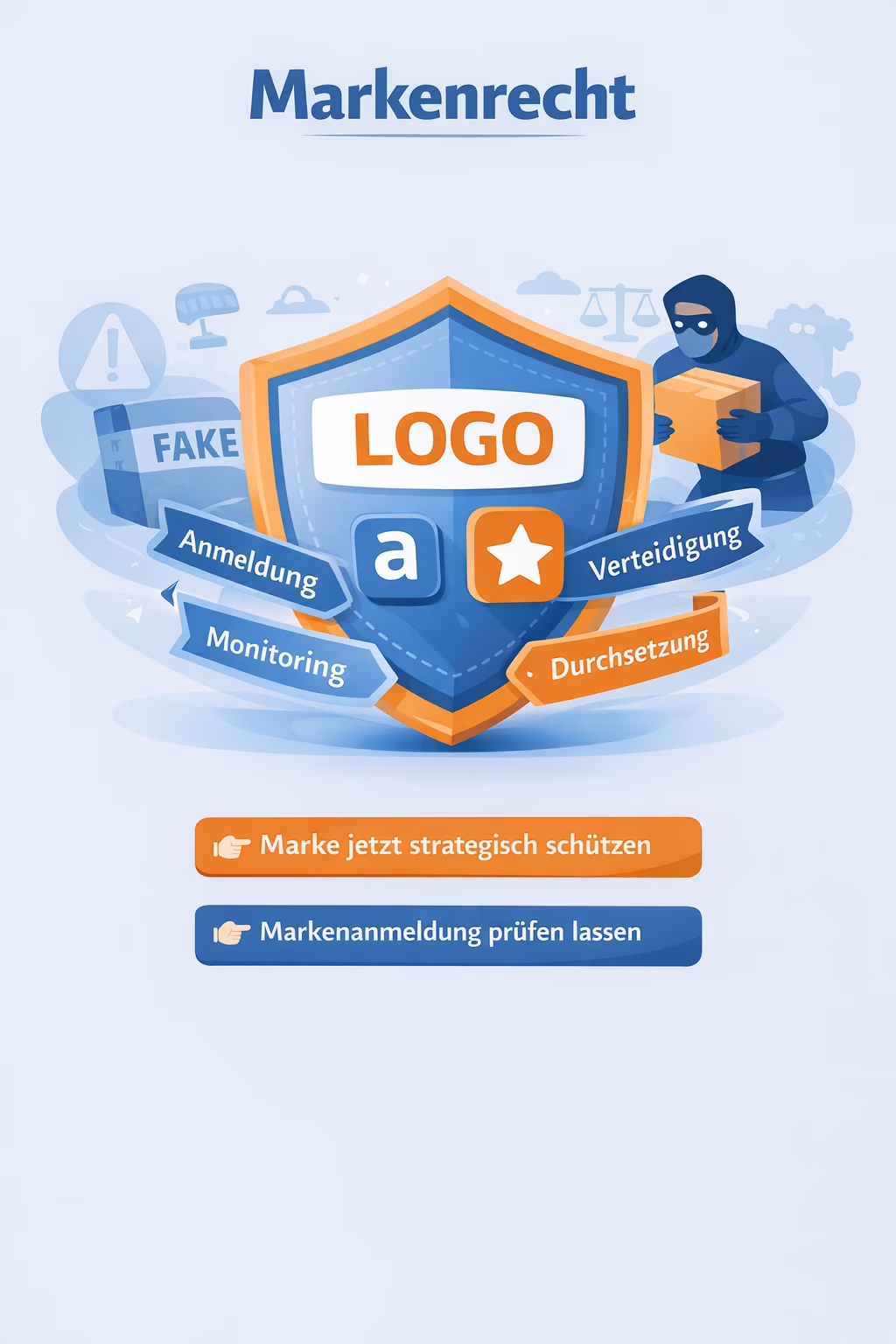
Whether product name, logo, claim, app name or platform branding: without effective trademark protection, there is a risk of Abmahnungen, fakes, listing hijacking or expensive rebrandings. In the first step, we bring together sign, target countries, classes, use and deadlines. From this, it follows which next step makes commercial sense.
Next steps: Register a trademark · Opposition against a trademark · Trademark lawsuit
Further articles (in German)
These articles go into typical individual questions on trademark registration, trademark infringement and register practice: What is a trademark? · BGH (Federal Court of Justice): Amazon / Ortlieb · Fake invoices after trademark applications
ITMR Rechtsanwälte PartGmbB · Düsseldorf · Trademark lawyer | Protect, defend, enforce your trademark.
The legal assessment always depends on the sign, the environment of goods or services, earlier rights and the connection to individual countries. The actual use and the status of the specific conflict also count.
Legal status: 23 October 2026. Reviewed on 23 October 2026 (German version).