Lawyer for media law: reputation, press and content
For companies, brands and people in the spotlight – reputation protection, press enquiries, social media and content.

Media law for companies, brands, platforms and visible communication
As a law firm from Düsseldorf with a Fachanwalt für Urheber- und Medienrecht (certified specialist lawyer for copyright and media law), ITMR Rechtsanwälte advises companies, agencies, publishers, platform operators, investors, communications managers and publicly visible people throughout Germany. As media lawyers in Düsseldorf, we represent you nationwide in press, reputation and social media matters.
As media lawyers, we know: media law is rarely just about a single article or a single statement. It is about visibility, impact, rights, proceedings and commercial consequences all at once. Media law decides the legal viability of public communication, published content, platform-based reach, commercial exploitation and reputation-critical situations.
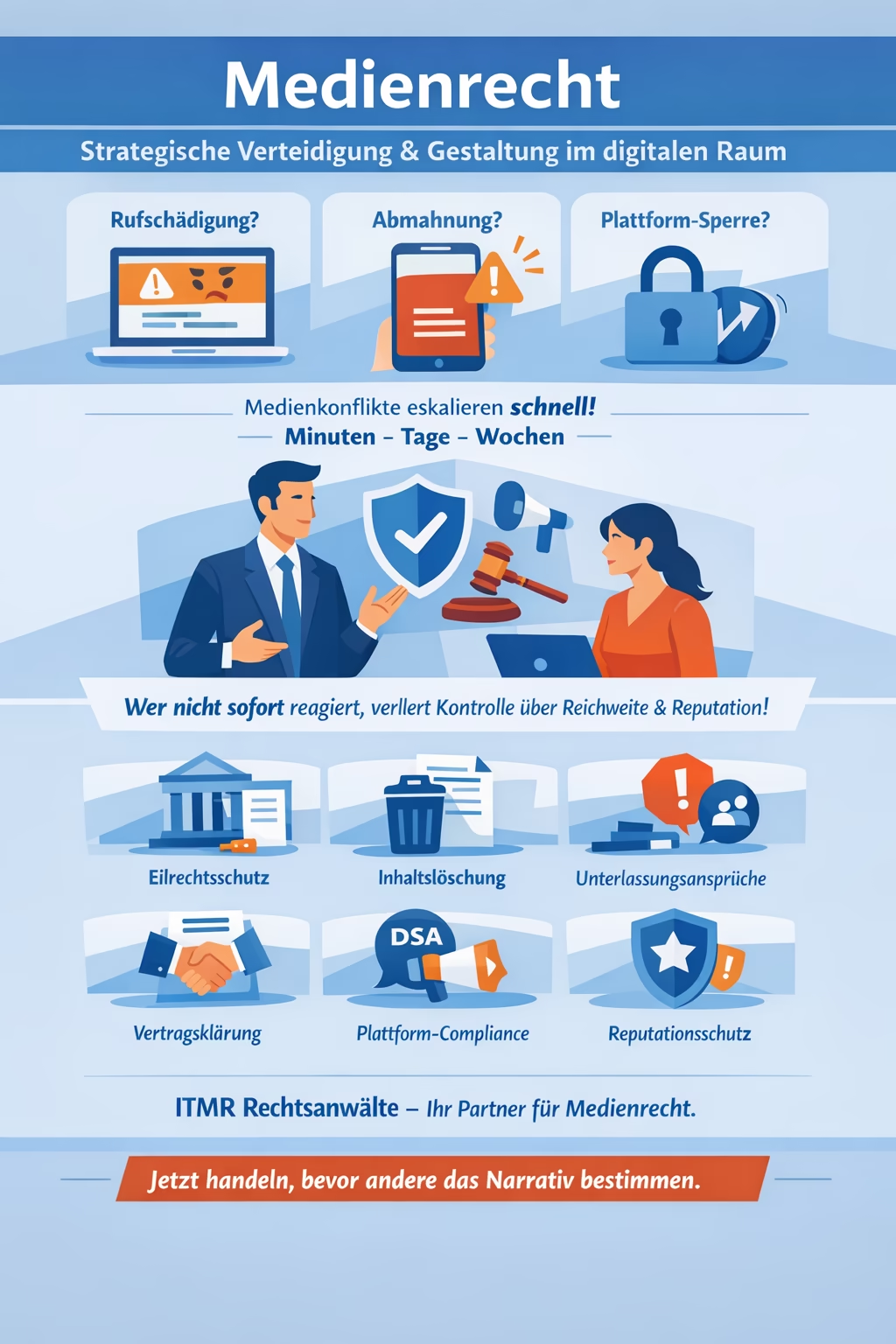
Critical press enquiries, blocked business accounts, review attacks, search results, fake profiles and unresolved buy-outs are part of this. So are creator and agency constellations, DSA-related platform procedures or campaigns ready for publication with an unclear approval situation. They show how closely media law is linked today with press law, social media law, reputation protection, copyright law, licensing, advertising law and competition law.
Anyone who communicates visibly, disseminates content, builds reach via platforms or exploits content commercially therefore does not need a general introduction. What is needed is a robust legal line for publication, exploitation, conflict and response.
Responsible for content: Jean Paul P. Bohne, Fachanwalt für IT-Recht (certified specialist lawyer for IT law), Fachanwalt für Urheber- und Medienrecht (certified specialist lawyer for copyright and media law), AI Officer (DEKRA), reviewed on 23 October 2026 (German version)

Your contact: Jean Paul P. Bohne
Fachanwalt für Urheber- und Medienrecht · Fachanwalt für IT-Recht (certified specialist lawyer for copyright and media law · for IT law)
What happens after your enquiry?
After your enquiry, we get back to you within 24 hours on working days. The first contact is free of charge. We let you know explicitly before any costs are incurred.
- A short description is enough. Links or screenshots of the article, account or platform data and any existing letters are helpful. Please also state planned publication dates and running deadlines.
- Receipt and initial sorting. We assess the enquiry on the basis of the project described, the documents and the apparent goal. Deadlines and dates should be clearly recognisable.
- Suitable starting point and cost range. We clarify whether an initial consultation, a service package or a specific mandate is the next step. As soon as the scope of the review is clear, we tell you the cost range – before work begins.
Your contact is Jean Paul P. Bohne and his team. He is a Fachanwalt für Urheber- und Medienrecht (certified specialist lawyer for copyright and media law) and a Fachanwalt für IT-Recht (certified specialist lawyer for IT law).
- Publication and press conflicts
- Platform and social media conflicts
- Reputation protection and deletion strategies
- Content rights, buy-outs and exploitation
- Media contracts and approval processes
- Notice-and-action and DSA aspects
Typical constellations with immediate pressure to act
Media law becomes particularly relevant to action where publication, platform, reputation and commercial exploitation all weigh on the same set of facts at once.
Reporting or corporate communication escalates
A critical press enquiry, imminent publication, counter-statement, pressure for an injunction or identifying image and text reporting require rapid assessment and a precise response architecture. For press enquiries and threatened reporting, the interactive press check provides an initial structure for the response.
Platform or business channel becomes operationally critical
Instagram, LinkedIn, TikTok, YouTube, Amazon or other accounts are restricted, blocked or burdened in their reach. This already affects sales, communication or brand management.
Digital reputation tips over
Fake profiles, unlawful content, search results, review attacks or identity-related damage to reputation create pressure because visibility and commercial external impact are affected at the same time.
Content project or campaign is not robustly approved
Chains of rights, buy-outs, consents, agency or creator structures and multi-channel uses do not hold up commercially, although publication or roll-out is already imminent.
Contract and exploitation logic are too weak
Production, publishing, agency, creator or platform contracts do not reflect approvals, scope of use, sublicensing, archive use or escalation paths precisely enough.
DSA or notice-and-action procedures begin
Notices, complaint procedures, obligations to state reasons and coordinated enforcement against platforms must properly combine substantive law, evidence and procedural strategy.
- Press law for reporting, counter-statements, injunctive relief, reporting on suspicions, image publication and urgent legal protection in speech law.
- Social media law for platform rules, labelling, creator models, business accounts, social commerce and account suspensions.
- Reputation protection for deletion, fake profiles, search results and review attacks.
- Licensing and rights clearance, copyright law or publishing law for buy-outs, chains of rights, rights of use, archive exploitation and content contracts.
In brief
We advise nationwide on press and platform conflicts, reputation protection, content rights and media contracts. Your contact is a Fachanwalt für Urheber- und Medienrecht (certified specialist lawyer for copyright and media law).
What media law is really about for companies
Media law comprises the legal order of public communication, published content, platform-based reach, commercial exploitation and reputation-critical conflicts. For professional actors, it is rarely just about a single article or a single statement. It is regularly about market impact, visibility, rights, proceedings and commercial consequences all at once.
Some publish campaigns, have content produced or played out, run business models via platforms or commission third parties with content. Others depend on search and review environments. All of them move at the same time within publication risks, chains of rights, contract logic, questions of deletion and defence, as well as procedural situations close to speech and platform law.
The focus is not on abstract doctrines, but on robust decisions on publication, approval, exploitation, platform access, response and protection of the business's external image.
This becomes particularly clear when one and the same event touches several levels. A publication can be open to challenge under speech law and at the same time burden search results and reputation. It can escalate secondarily on social networks and additionally raise rights issues from image, video, creator or contract material. That is exactly where it is decided whether communication remains viable or tips into a costly conflict.
- Publication and communication concern statements, interviews, campaigns, articles, use of images and video, and the legal viability of public statements.
- Platform and visibility concern moderation, suspensions, complaint procedures, terms, search and review environments, hosting, reach and distribution.
- Reputation protection concerns unlawful content, digital attacks, search results, review pressure and identity-related infringements with commercial external impact.
- Content and exploitation concern approvals, buy-outs, chains of rights, sublicensing, archive use and cross-platform distribution.
- Media contracts concern agencies, creators, productions, publishers, platform models and the question of whether contracts actually support publication and exploitation.
Press law for reporting, journalistic diligence, counter-statements, image publication, reporting on suspicions and urgent legal protection in speech law. Social media law for platform rules, labelling, creator structures, accounts and social commerce. Reputation protection for deletion, fake profiles, search results and review attacks. Licensing and rights clearance, copyright law or publishing law for buy-outs, rights of use, approvals and exploitation.
Is the matter already under way and time is pressing?
Then the assessment before the first response is what counts.
Media law connects publication, platform, reputation, content exploitation and contracts. One event often touches several of these levels at once.
Which case situation leads where
The more clearly the focus of a situation is captured, the more precisely the most relevant legal route can be chosen.
Reporting, image publication, counter-statement, injunctive relief
If the article, headline, interview, journalistic research, reporting on suspicions or image reporting carries the situation, the focus regularly lies in press law. There, statements of fact, value judgements, balancing, counter-statements and interim legal protection are covered in depth.
Business accounts, platform rules, creator models, labelling, social commerce
If platform practice, labelling, moderation, social commerce processes, creator cooperations or losses of reach shape the case, social media law is the more precise follow-up.
Fake profiles, review attacks, search results, digital damage to reputation
When removal, containment and stabilisation of the digital external image are in the foreground, the route via reputation protection usually leads more directly to the actual measure.
Business-critical channel blocked or restricted
In the case of an acute suspension, speed, documentation and the right order of escalation count. For immediate operational action, social media account suspension is regularly the sharper path.
Business-damaging reviews on Google, Kununu, Jameda or platforms
If the problem condenses into reviews or coordinated waves of reviews, having reviews deleted leads more quickly to the actual measure.
Chain of rights, buy-out, approval, archive use, international distribution
Is it not the publication itself that is shaky, but the commercial usability of content? Then the centre regularly shifts to licensing and rights clearance, copyright law or publishing law.
Constellations in which publication, platform, reputation and exploitation are affected at the same time are particularly demanding. The actual focus must then first be properly worked out from the overall picture.
In brief
Press, social media, reputation, account suspension, reviews and chains of rights each lead to their own focus page. We clarify which situation carries your case.
The core fields of media law
In a professional environment, media law is shaped above all by those lines of conflict in which commercial pressure, public visibility, rights issues and speed of response coincide.
Content projects and publication-related structuring
This is about conception, production, approvals and coordination between brand, agency, creator, publisher or platform. It must also be clarified whether materials, statements and uses were actually reviewed robustly before publication. The focus is not only on intellectual property rights, but on clean processes, clear approval logic and viable contract structures.
Publication risks and press-related escalation
The focus here is on reporting, corporate communication, counter-statements, injunctive relief, image reporting, consequences in search results and reputation-damaging statements of fact. The in-depth specialist subject for this lies in press law.
Platform and distribution issues
This is about moderation, suspensions, complaint procedures, visibility, terms, hosting and monetisation. In addition, there is the commercial exploitation of content via platforms and across several channels. As soon as social media practice and platform logic dominate, the next step leads to social media law.
Reputation protection and digital visibility
Reputation protection concerns not only obvious attacks, but every commercially relevant form of unlawful digital external impact. This includes fake profiles, defamation, false reviews, identity-related search results, coordinated attacks and essentially identical repetitions. It must also be clarified how notice, deletion, pressure from lawyers and court action interact.
Media contracts, buy-outs and chains of rights
In everyday business, media law is often also contract law for content. This includes production contracts, creator and agency contracts, approvals, buy-outs, publishing and distribution models, sublicences, multi-channel use and archive exploitation. The commercial weak point often lies not in the creative work itself, but in the lack of robustness of the agreed chain of rights.
Is a campaign, production or publication about to start and the approval situation unclear?
We review the approval in advance.
Anyone who publishes, disseminates or plays out content, runs it on platforms or manages risks relevant to the public needs more than mere defence. What is needed is a robust order for publication, exploitation and response.
Copyright law, licensing and rights clearance, publishing law, advertising law and competition law explore the questions in which protection, ownership of rights, contract structure or market conduct form the actual centre.
Five core fields shape media law: content projects, publication risks, platform issues, reputation protection and media contracts with chains of rights.
When you need us
In media law, costly mistakes rarely arise from a lack of creativity, but from wrong prioritisation. People react too late, think too narrowly, approve too carelessly or publish too early.
- A company is confronted with incorrect facts, abbreviated classification or reputation-damaging images. Under great time pressure, it must decide on injunctive relief, counter-statement, correction, deletion or accompanying communication measures.
- A management, founder or publicly visible personality is attacked on platforms, in search engines or on social networks with fake profiles, false reviews or content infringing personality rights.
- A campaign, production or publication is about to start, but chains of rights, buy-outs, consents, advertising uses or sublicences are not documented in a commercially robust way.
- A business-critical channel on Instagram, TikTok, YouTube, LinkedIn, Amazon or a comparable service is restricted or blocked. The loss of reach, leads or community is already affecting operational key figures.
- Platform operators, media companies or rights holders must handle notices, deletion requests, internal complaints or procedures under the Digital Services Act not only doctrinally but in an organisationally robust way.
- Agencies, publishers, creator businesses or brands do not just want to resolve individual conflicts. They want to set up publication approvals, contracts, creator set-ups and escalation paths in a permanently stable way.
- Article 5 Grundgesetz (opens in a new tab) for freedom of opinion, of the press and of information.
- Section 22 Kunsturhebergesetz (opens in a new tab) and Section 23 Kunsturhebergesetz (opens in a new tab) for portraits and exceptions.
- Urheberrechtsgesetz (German Copyright Act) (opens in a new tab) for protection, ownership of rights and rights of use in creative works.
- EUR-Lex on the Digital Services Act (opens in a new tab) for the EU procedural framework for digital services.
- Bundesnetzagentur (Federal Network Agency) as German Digital Services Coordinator (opens in a new tab) for the supervisory context and further information.
Typical mandates concern false reports, attacks on individuals, uncertain chains of rights, blocked channels, DSA procedures and the permanent set-up of approval processes.
Typical cases from our media law practice
We regularly encounter the following constellations. They are abstracted and simplified. Which claims exist always depends on the specific facts.
PlatformBlocked business account
- Starting point
- A retailer's Instagram channel is blocked without comprehensible reasons. A large proportion of enquiries came via this channel.
- Key difficulty
- The Digital Services Act requires a statement of reasons for the suspension and an internal complaint procedure (Art. 17, 20 DSA).
- Our work
- We secure the documentation, use the complaint procedure and examine civil law action against the platform.
- Work result
- A reasoned complaint, a letter of demand to the platform and an assessment of court options.
Simplified example.
ContentCampaign with an unclear buy-out
- Starting point
- An agency has produced photos and videos for a campaign. Now they are also to run internationally and in paid social.
- Key difficulty
- The contract regulates the scope of use only in general terms. Under Section 31 UrhG, the scope of the rights of use is, in case of doubt, determined by the purpose of the contract.
- Our work
- We review the chain of rights, the consents of the persons depicted and the contract with the agency and production.
- Work result
- A list of gaps, a supplementary agreement on the buy-out and an approval checklist for future campaigns.
Simplified example.
Work sample
Press enquiry with a short deadline before publication
A magazine announces a critical report about a company and requests a statement within two days. The real difficulty: it must be clarified which statements are statements of fact and which are value judgements. Portraits of employees may also be affected (Sections 22, 23 KUG). We classify the announced statements, draft the statement and examine preventive steps. Result of our work: a coordinated statement, a letter of notice to the editorial team and a prepared line for injunctive relief or a counter-statement.
The scenario is anonymised and simplified; it describes how we work, not the outcome of any specific proceedings.
Typical cases are a press enquiry with a short deadline, a blocked business account and a campaign with an unclear buy-out.
Media case under time pressure?
We assess the situation before the first response.
Services and work results at a glance
We determine which service fits after the initial assessment. The table shows typical work results and the page with further details.
| Service | Work result | More |
|---|---|---|
| Conduct press conflictPress | Statement, warning letter, counter-statement or application for a preliminary injunction. | Press law |
| Remove reputation-damaging contentReputation | Deletion requests to platforms and search engines, and court action. | Reputation protection |
| Challenge reviewsReviews | Review of and complaints about unlawful reviews. | Having reviews deleted |
| Restore accountPlatform | Complaint under the DSA and demand to the platform. | Social media account suspension |
| Secure social media practiceSocial media | Review of labelling, creator contracts and platform rules. | Social media law |
| Clear rightsLicensing | Review of the chain of rights and licence or buy-out contracts. | Licensing and rights clearance |
| Ongoing supportStructure | Approval processes, contract templates and fixed contacts. | outsourced legal department · contract management |
In brief
Every matter has a clear work result. The link under “More” leads to details and the matching service package.
How media law mandates are handled
A media law case above all requires the right sequence. Facts, reach, platform, evidence, commercial pressure and response goal must be sorted so that the most effective lever becomes apparent early.
1. Precisely record facts, visibility and the publication picture
We record content, archives, screenshots, dissemination, platform paths, search and review environments, parties involved and the chain of rights. Added to this is the commercial pressure on brand, sales, financing, transaction or ongoing communication.
2. Determine the main focus
What matters is whether the core of the situation lies in press, platform, reputation, account access, content rights, approval, creator model or contract logic. This determines the right first measure. That can be a notice, a warning letter, court pressure, contract adjustment or communication support.
3. Choose the most effective instrument
Depending on the case, a platform notice, a lawyer's letter of demand, advance review, correction of approvals and contracts, a preliminary injunction, an action, a complaint procedure or controlled support of external communication may be considered.
4. Prevent repetitions and consequential damage
After the acute handling, the focus is often on better approvals, social media governance, creator and agency contracts, robust chains of rights, documentation and escalation paths. The aim is a structure that makes future publication situations more stable.
With viral dissemination, planned publication, account access, waves of reviews, consequences in search results or urgent legal protection in speech law, every delay worsens the position. Sorting things out too late often costs pressure, reach, room for negotiation or certainty of evidence.
Is a channel blocked, a wave of reviews under way or a publication announced?
Describe the acute situation to us.
We record the facts, determine the focus, choose the most effective instrument and prevent repetitions.
Media law terms briefly explained
- Tatsachenbehauptung (statement of fact)
- Statement whose truth can be verified with evidence. Untrue statements of fact are generally not protected.
- Werturteil (value judgement)
- Expression of opinion characterised by taking a position and personal view. It is broadly protected by Art. 5 GG.
- Verdachtsberichterstattung (reporting on suspicions)
- Report on a suspicion not yet proven. Permissible only with a minimum body of supporting facts, a hearing of the person concerned and a balanced presentation.
- Gegendarstellung (counter-statement)
- Right of the person concerned to publish their own account of facts. Regulated in the Landespressegesetze (State Press Acts) and the Medienstaatsvertrag (Interstate Media Treaty).
- Recht am eigenen Bild (right to one's own image)
- Portraits may in principle only be disseminated with consent (Section 22 KUG). Exceptions are regulated in Section 23 KUG.
- Buy-out
- Contractual settlement of comprehensive rights of use against a lump-sum fee. The scope must be described precisely.
- Notice-and-action
- Notice and action procedure for illegal content at hosting services (Art. 16 DSA).
- Kerngleiche Inhalte (essentially identical content)
- Content that essentially matches prohibited content. Obligations to cease and desist can also extend to it.
The explanations are simplified. The statutory text and case law in the individual case are decisive.
Statutes and case law in media law
The following table brings together provisions and decisions that frequently carry media law mandates. The links lead to the official text.
| Provision | Content | Practical significance |
|---|---|---|
| Art. 5 GG (opens in a new tab) | Freedom of opinion, of the press and of information | Standard for any balancing against personality rights. |
| Section 22 KUG (opens in a new tab) | Right to one's own image | Dissemination of portraits in principle only with consent. |
| Section 23 KUG (opens in a new tab) | Exceptions | Portraits from contemporary history, assemblies and incidental subjects. |
| Section 31 UrhG (opens in a new tab) | Grant of rights of use | Where the contract is unclear, the purpose of the contract is the standard. |
| Section 823 BGB (opens in a new tab) · Section 1004 BGB (opens in a new tab) | Damages and injunctive relief | Basis of civil law claims for infringements of personality rights. |
| Sections 935, 940 ZPO (opens in a new tab) | Preliminary injunction | Urgent legal protection where there is urgency. |
| Art. 16, 17, 20 DSA (opens in a new tab) | Notice procedure, statement of reasons, complaint | Procedural rights against platforms in cases of deletion and suspension. |
| CJEU, judgment of 03.10.2019 – C-18/18 (opens in a new tab) | Glawischnig-Piesczek | Hosting providers can be obliged to also remove identical and equivalent content. |
Art. 5 GG, KUG, UrhG and BGB form the core. The DSA adds procedural rights against platforms.
Media law at ITMR
Media law mandates become particularly demanding where publication, platform practice, reputational risk, contract logic, chains of rights and enforcement in court interlock. It is precisely at this interface that we work as media lawyers, with a perspective that brings together media, IT, IP, platform and conflict issues.
Specialist depth where it visibly counts
Jean Paul P. Bohne, LL.M., MM is a Fachanwalt für Urheber- und Medienrecht (certified specialist lawyer for copyright and media law) and at the same time a Fachanwalt für IT-Recht (certified specialist lawyer for IT law). This is particularly valuable when media law must be resolved not only in terms of speech law but also in terms of platforms, technology or contracts.
Interface expertise beyond the actual media topic
Whether advertising law, copyright law, competition law, data protection law or IT law: many media cases tip precisely at these transitions. That is where it is decided whether a line remains commercially viable or breaks down into parallel conflicts.
Conflict management and structural work from a single source
You do not just want to resolve an individual case, but to set up publications, approvals, contracts and communication processes in a permanently more stable way? Then media law can be interlinked with an outsourced legal department and contract management.
Jean Paul P. Bohne, LL.M., MM is close to press, platform, contract and chain-of-rights mandates of high commercial weight. Anna Ciuraj is a particularly obvious choice for publication and production constellations related to media, press and copyright. Emma-Marie Kürsch is a strong contact when content, brand, publication, exploitation and digital communication closely converge.
We combine media law with IT, IP, data protection and competition law. A Fachanwalt für Urheber- und Medienrecht (certified specialist lawyer for copyright and media law) leads the mandates.
In-depth articles from the ITMR blog
The following articles cover media law situations in detail, with statutes, decisions and the procedural route. They supplement this page where the assessment has turned into a specific question.
Case law atlas on speech law
Key holdings from decisions of the Bundesverfassungsgericht (Federal Constitutional Court), the Bundesgerichtshof (Federal Court of Justice) and the Oberlandesgerichte (Higher Regional Courts), ordered by ten review steps. The reference work behind every assessment under speech law.
Taking action against a media report
Injunctive relief, counter-statement, correction and deletion compared, with the deadlines and the first step after publication.
Deepfakes: personality rights and takedown
Which claims apply when the recording is artificially generated, and how removal is enforced against the platform and the disseminator. Specifically on cloned voices: Voice misuse through AI.
Liability of hosting providers under the DSA
Notice-and-action, complaint procedures and obligations to state reasons: how the EU procedural framework organises enforcement against platforms.
The fliegender Gerichtsstand (forum shopping) in publication matters
Where to sue over online publications, which choice remains and which chambers take which line.
Warning letter and preliminary injunction
What a warning letter must achieve, when the urgent application holds and which deadlines jeopardise urgency.
Frequently asked questions
The following answers provide a robust initial orientation for companies, communications managers, agencies, platform cases and reputation-related conflicts. Which claims exist and which route holds up commercially always depends on the specific facts.
When is a case media law and when rather press law?
Media law is the broader framework. Press law is closer when reporting, journalistic diligence, counter-statements, injunctive relief, reporting on suspicions or image publications are at the centre. The same applies to balancing freedom of communication against protection of personality. If, instead, platform rules, business accounts, reviews, fake profiles, chains of rights, buy-outs or contractual approvals shape the case, media law remains the main classification. A focus then often lies in social media law, reputation protection or licensing and rights clearance. ITMR Rechtsanwälte assigns your case to the appropriate focus at the outset.
What is particularly important in the case of reputation-damaging reporting or false facts?
Speed, documentation and the proper classification of the statement are decisive. Legally, it makes a considerable difference whether a specific statement of fact, a value judgement, reporting on suspicions or an image publication is affected. Anyone who reacts too late often loses tactical options in urgent legal protection and worsens the evidential position. As soon as publication and balancing carry the case, press law is regularly the most relevant in-depth page. ITMR Rechtsanwälte secures evidence and examines urgent legal protection.
What role does the Digital Services Act play in a platform conflict?
The Digital Services Act reorganises notice routes, obligations to state reasons, internal complaint procedures and other obligations of digital services. However, it does not automatically answer the substantive question of whether content is unlawful in the individual case or whether a suspension must be lifted. It creates important procedural levers but does not replace the legal assessment of the individual case. For the in-depth implementation question, implementing the DSA is the more relevant follow-up. ITMR Rechtsanwälte uses these procedural rights in a targeted way for your case.
Is a platform notice sufficient or are parallel civil law steps needed?
That depends on the pressure in the specific case. With clearly unlawful content, a precisely reasoned platform notice can take effect quickly. With high reach, repeated infringements, essentially identical content, refused removal or considerable commercial damage, this is often not enough. Then injunctive relief, interim legal protection or other civil law steps must be considered early. ITMR Rechtsanwälte coordinates notice and court action.
Where do image, video and content approvals in companies fail most often?
Typical mistakes lie in unclear chains of rights, buy-outs worded in general terms, missing rights to edit, incomplete consents and unresolved personality rights. Added to this are poorly documented approvals for later campaigns, archive use or international roll-outs. What is considered approved internally is often only partly robust legally. When these questions carry commercial weight, licensing and rights clearance often becomes the decisive follow-up. ITMR Rechtsanwälte reviews chains of rights before a campaign starts.
When is ongoing media law support more worthwhile than a one-off enquiry?
Ongoing support is particularly useful when public communication, platform presence, campaigns, creator models, rights approvals and reputational risks occur repeatedly. Early structure is then usually cheaper than later repair under pressure. For this need, an outsourced legal department and contract management often make more commercial sense than purely ad hoc responses. ITMR Rechtsanwälte offers both as ongoing support.
React acutely or structure as a precaution
Media law risks rarely become smaller while there is still internal discussion about whether it is a press case, a platform case, a reputation case or an exploitation problem. What matters is that the right route is chosen early.
Acute situation with escalation pressure
You need a short-term assessment of reporting, a review attack, a fake profile, a business account suspension, a search result problem, a DSA issue or a publication with considerable reputational risk.
Prevention, approvals and ongoing support
You want to set up publications, campaigns, chains of rights, platform practice, contracts, creator structures and internal approvals so that later escalations do not become expensive.
ITMR Rechtsanwälte PartGmbB · Düsseldorf · Fachanwalt für Urheber- und Medienrecht (certified specialist lawyer for copyright and media law) | Media contracts & press freedom
Legal status: 23.10.2026. Reviewed on 23.10.2026. This presentation provides initial orientation and does not replace a review of the specific case.
Change log
- Page restructured. Typical cases, service table, terms as well as statutes and case law newly added. Contacts, legal status and professional responsibility added. Existing content and links have been retained.
- Section “In-depth articles from the ITMR blog” newly added. The four inserted calls to action with their own headings have been replaced by three prompts in the running text that do not claim a heading level. Legal status line with firm's registered office, directory entry and this log newly added.
- First version
- Core page media law with classification, case situations, core fields, mandate examples, approach, contacts, frequently asked questions and conclusion.
Responsible lawyer for media law at ITMR
Jean Paul P. Bohne, LL.M., MM
Rechtsanwalt (attorney) | Partner | Business mediator
- Fachanwalt für Urheber- und Medienrecht (certified specialist lawyer for copyright and media law)
- Fachanwalt für IT-Recht (certified specialist lawyer for IT law)
- AI Officer [DEKRA]
- Certified Information Privacy Professional/Europe [CIPP/E]
- Cert. Information Privacy Manager [CIPM]
- External data protection officer [TÜV]
- Data protection officer [TÜV]
- Data protection auditor [TÜV]
- IT compliance manager [TÜV]
T: +49 211 737547-70
E: bohne@itmr-legal.de

Emma-Marie Kürsch
Rechtsanwältin (attorney) | employed
T: +49 211 737547-70
E: kuersch@itmr-legal.de

Otto Weidenkeller
Rechtsanwalt (attorney) | employed
T: +49 211 737547-70
E: weidenkeller@itmr-legal.de

Anna Ciuraj
Rechtsanwältin (attorney) | employed
T: +49 211 737547-70
E: ciuraj@itmr-legal.de

Dr. Marianna Voutichti, LL.M.
Rechtsanwältin (attorney) | freelance
T: +49 211 737547-70
E: voutichti@itmr-legal.de