Lawyer for competition law: UWG warning letters and injunctions
For companies facing UWG (Gesetz gegen den unlauteren Wettbewerb, German Act against Unfair Competition) infringements – rapid defence against Abmahnungen (formal warning letters), greenwashing allegations and misleading advertising.

When advertising, sales or platform logic turns into a UWG conflict
ITMR Rechtsanwälte represents companies nationwide in competition law, i.e. in cases of unfair competition under the UWG, Abmahnung (warning letter), Unterlassungserklärung (cease-and-desist declaration), einstweilige Verfügung (preliminary injunction) and the enforcement of their own claims.
A warning letter in the inbox. A draft cease-and-desist declaration on the table. A contractual penalty looming. An urgent application announced. Or the other way round: a competitor is overtaking you with misleading advertising, pricing logic, presentation of reviews or aggressive market communication and needs to be stopped at short notice.
In competition law, it is not enough for an allegation to sound somehow legally tenable. What matters are deadlines, standing (Aktivlegitimation), the scope of the prohibition demanded, preservation of evidence, technical feasibility and the question of which response your company can bear commercially. This is often where it is decided whether a case remains manageable or tips into injunction, coercive measures (Ordnungsmittel), contractual penalties and follow-on conflicts.
The focus is on warning letters, cease-and-desist declarations, preliminary injunctions and the enforcement of your own claims under the Gesetz gegen den unlauteren Wettbewerb (UWG, German Act against Unfair Competition). Antitrust law under the Gesetz gegen Wettbewerbsbeschränkungen (GWB, German Act against Restraints of Competition) is not meant here.
- for companies and professional market participants
- nationwide in UWG conflicts
- dispute-oriented in advertising, e-commerce and digital sales
Responsible for content: Jean Paul P. Bohne, Fachanwalt für IT-Recht (certified specialist lawyer for IT law), Fachanwalt für Urheber- und Medienrecht (certified specialist lawyer for copyright and media law), AI Officer (DEKRA), reviewed on 23 October 2026 (German version)
Quick start: what is your matter about?
Received an Abmahnung (formal warning letter)?
Secure deadlines, do not sign a cease-and-desist declaration without review and define the line of response.
Preliminary injunction
File or defend against an application for an injunction, with the Abschlusserklärung (final declaration) and coercive measures in view.
Send a warning letter to a competitor
Secure evidence, define the core of the prohibition precisely and prepare the first enforcement step.
Emergency mode for warning letters
The emergency mode structures the first steps when a warning letter with a short deadline arrives.

Your contact: Jean Paul P. Bohne, LL.M., MM
Partner, certified specialist lawyer for copyright and media law and for IT law (Fachanwalt für Urheber- und Medienrecht, Fachanwalt für IT-Recht).
What happens after your enquiry?
After your enquiry, we get back to you within 24 hours on working days. The first contact is free of charge. Before any costs arise, we point this out to you explicitly.
- A short description is enough. Send the warning letter, draft cease-and-desist declaration, advertising materials, shop versions, screenshots, approvals and all deadlines. It can then be quickly assessed which line is viable.
- Receipt and initial sorting. We assess the enquiry on the basis of the project described, the documents and the apparent goal. Deadlines and dates should be clearly recognisable.
- Suitable starting point and cost range. We clarify whether an initial consultation, a service package or a specific mandate is the next step. As soon as the scope of the review is clear, we tell you the cost range – before work begins.
In brief
If a deadline, an application for an injunction or a contractual penalty is already in play, advertising materials, shop versions, screenshots, price versions, newsletter sequences, review displays and internal approvals should be secured immediately. Hastily signing a pre-drafted cease-and-desist declaration often merely shifts the risk into the future.
Typical cases from our competition law practice
The following constellations are abstracted and simplified. Which line holds up always depends on the claim, the evidence, the deadline and the business model.
EnforcementCompetitor advertises with star ratings
- Starting point
- A competitor highlights an average rating without making the basis of calculation transparent. The display continues during your own campaign.
- Key difficulty
- Screenshots, points in time, visibility and platform context must be robustly documented. Only then can the core of the prohibition be defined in a viable way.
- Our work
- We secure evidence and weigh an out-of-court warning letter against urgent proceedings according to urgency and market impact.
- Work result
- A documented body of evidence and a warning letter or a prepared application for an injunction.
Simplified example.
Urgent proceedingsPreliminary injunction served
- Starting point
- A company receives a preliminary injunction over a product claim. The challenged statement still appears in newsletter sequences and social media posts.
- Key difficulty
- Enforcement, scope of the prohibition, Kerngleichheit (substantially identical conduct) and the risk of coercive measures must be clarified. At the same time, a decision must be made on a final declaration or an objection.
- Our work
- We review the injunction and the factual basis, manage implementation in advertising materials and develop the follow-up strategy.
- Work result
- A clear decision on a final declaration or defence and documented implementation.
Simplified example.
Work sample
Warning letter over strike-through prices in the shop
An online retailer receives a warning letter over strike-through prices and “today only” claims. Attached are a demand for costs and a broadly worded draft cease-and-desist declaration. The real difficulty: standing, a specific competitive relationship and the scope of the core of the prohibition must be clarified. The shop version must be documented before any change. We secure deadlines and the current state, review the claim and the contractual penalty model and prepare a rejection or modification. Result of our work: a coordinated response and, where appropriate, a modified cease-and-desist declaration with a manageable scope.
The scenario is anonymised and simplified; it describes how we work, not the outcome of any specific proceedings.
What you will have at the end
| Service | Concrete result | Next step |
|---|---|---|
| Review and defend warning letters | Assessment of claim, standing, amount in dispute and cost risk | Forward warning letter with deadline |
| Negotiate cease-and-desist declaration | Declaration with a manageable core of prohibition and contractual penalty model | Send the other side's draft |
| Preliminary injunction | Application, defence or final declaration | Briefly describe the urgency |
| Enforce claims | Preservation of evidence, formulation of claims and warning letter | Send screenshots and sources |
| Readjustment | More robust advertising approvals, pricing logic and shop set-ups | Arrange a call about your needs |
What competition law specifically covers here
At its core, the question is when market communication, sales, platform conduct or sales strategies trigger an obligation to cease and desist. And it is about how this obligation is enforced out of court or in court. Besides the abstract infringement, what matters above all is the combination of legal basis, competitive relationship, risk of repetition, provability and commercial scope.
Competition law becomes acute when market conduct turns into an injunction risk
- a warning letter with a deadline and a demand for costs arrives,
- a cease-and-desist declaration is demanded,
- a preliminary injunction is being prepared or has already been served,
- a competitor is to be stopped for misleading advertising, inadmissible pricing logic, problematic reviews or aggressive solicitation,
- the next decision has to be made under considerable time pressure.
Legal orientation for attack and defence
The central basis is the Gesetz gegen den unlauteren Wettbewerb (UWG, German Act against Unfair Competition) (opens in a new tab). Particularly important in conflict situations are the injunctive claim, the prohibition of abuse in Section 8c UWG (opens in a new tab) and the rules on urgent proceedings, for example in Section 929 ZPO (opens in a new tab). At European level, the Directive 2005/29/EC on unfair commercial practices (opens in a new tab) forms the central frame of reference.
Antitrust law under the Gesetz gegen Wettbewerbsbeschränkungen (GWB, German Act against Restraints of Competition) does not belong to this subject matter. This is about unfair commercial practices. Structural restrictions of competition are a separate topic.
Anyone who primarily wants to review a campaign before publication, align claims, structure price information or set up marketing processes in a legally compliant way is usually closer to advertising law, marketing law, product advertising or e-commerce. As soon as injunctions, warning letters, contractual penalties or court pressure dominate, competition law is in the foreground.
Typical triggers: misleading advertising, price advertising, review advertising, email marketing, platform displays, product claims. Typical risks: injunction, contractual penalty, coercive measures, final declaration, costs, damage to reach and reputation. Typical goals: fend off a warning letter, negotiate a declaration, control urgent proceedings or enforce claims against competitors.
The case typically becomes acutely relevant in misleading advertising, price advertising, review advertising, email marketing, social media campaigns, product claims, platform conflicts and breaches of market conduct rules in online retail. As soon as this results in an injunction, warning letter or urgent proceedings, it goes beyond marketing design to defence, enforcement and robust risk decisions.
When you need us
Most competition law mandates begin with a problem that suddenly costs money, reach or reputation. A clean legal classification is usually missing at the outset. That is why an early assessment along real case patterns is more valuable than an abstract catalogue of provisions.
Misleading advertising and price advertising
Eye-catching statements, strike-through prices, discount mechanics, references to RRP, “today only” claims or statements on availability quickly come into focus. For preventive review, advertising law is the narrower page. If a warning letter has already been issued or an injunction is in play, the contentious UWG level becomes decisive.
Review advertising and star ratings
Average ratings, highlighting individual reviews, lack of transparency about the basis of calculation or misleading presentation of review signals are prone to conflict. An important point of reference is the line of the Bundesgerichtshof (Federal Court of Justice) on average star ratings. A look at BGH: average star rating is also worthwhile.
Email advertising and newsletter sequences
Consent, proof, origin of addresses, opt-out mechanics and technical sending processes are often only examined more closely once an attack has already taken place. For a structural review before the conflict, the newsletter marketing check and marketing law are closer.
Claims, green claims and product communication
Environmental statements, promises of effect and claim-related product communication are legally demanding and sensitive for reputation. For reviewing the content of claims, product advertising is the more precise in-depth page. In a dispute, this is about injunction, burden of proof, scope and procedural strategy.
Social media, creator set-ups and labelling
Product tags, affiliate links, influencer labelling, story mechanics and performance-driven campaigns often lead to mixed conflicts of media, advertising and competition law. The ongoing design side belongs rather to social media law. The contentious response belongs here.
Online retail, platforms and market conduct rules
Mandatory information, price information, listing changes, platform displays and shop logic can be problematic both technically and under unfair competition law. For the structural foundation, e-commerce is closer. If this results in a warning letter, injunction or urgent proceedings, the competition law response logic is needed.
What we specifically handle in competition law
Whether an allegation appears formally tenable is only the beginning. What matters is which response protects your room for manoeuvre and which declaration you can comply with permanently. Equally important is how costs and risk develop and whether an attack against the opponent holds up out of court or in court.
Review and defend warning letters
We examine the competition law infringement, standing, a specific competitive relationship, the amount in dispute, urgency and cost risk. We then decide with you whether rejection, modification, settlement, a Schutzschrift (protective brief) or another response is the most sensible line. For immediate booking of the service, defend against a warning letter can also be used.
Negotiating cease-and-desist declarations with an eye to the future
The critical point is rarely just the specific allegation. Above all, overly broad cores of prohibition, unclear scopes, unmanageable review obligations and harsh contractual penalty mechanisms become dangerous. Anyone who signs wrongly here often produces follow-on conflicts instead of resolving the first one.
Apply for or defend against a preliminary injunction
In urgent proceedings, speed, density of facts, wording of the application and procedural discipline count. We develop the line for application, defence, final declaration, coercive measures and follow-up strategy. For a service focused on urgent proceedings, Preliminary injunction | cease-and-desist declaration is also available.
Enforcing your own claims against competitors
If a competitor unfairly distorts your market environment, you need evidence, a viable formulation of the claim and a realistic enforcement strategy. The first operational step can be prepared via send a warning letter.
Readjustment: Many disputes also show where future risks arise: in advertising approvals, pricing logic, lead processes, shop set-ups or claim-related product communication. For this downstream stabilisation work, marketing compliance advice, advertising law, marketing law or e-commerce often apply.
What counts now after receiving a warning letter
The first response often determines the further course more than the later legal fine-tuning. Anyone who gives in too early under deadline pressure or leaves the case lying too long gives away room for manoeuvre. Anyone who reviews in a structured way can still make sound decisions under pressure.
What counts in the first hours after the warning letter
Correctly assess deadline and pressure
Do not ignore it, but do not sign reflexively either. First it must be clear which deadline is really running and which escalation realistically threatens.
Record the current state in an evidence-proof way
Immediately document landing pages, shop versions, platform views, newsletters, stories, ads, price versions and internal approvals before anything is changed or deleted.
Do not commit to anything hastily
Cease-and-desist declarations, admissions of guilt or informal commitments can create a scope that unnecessarily narrows later room for manoeuvre.
Bundle the line of response internally
One person or a small team should steer which information is secured, which steps are examined and which statements are made to the opponent, the platform or internally.
Review steps after the warning letter
- Secure deadlines and the factual basis. Relevant landing pages, shop versions, platform views, price versions, newsletters, advertising materials, stories, product pages and internal approvals should be documented immediately. Without a robust factual basis, any defence remains vulnerable.
- Check the claimant and standing. Competitor status, association authority and a specific competitive relationship are not side issues. Especially in digital markets, it is often disputed how close services, target groups and sales interests actually are.
- Classify the infringement legally and cleanly. It must be examined whether there really is a misleading commercial practice, an unreasonable nuisance, an aggressive practice or a breach of a market conduct rule. Where data protection, platforms or products are involved, the classification is often not trivial.
- Check the cease-and-desist declaration for scope and practicability. Many templates are broader than the specific attack. Particularly problematic are unclear prohibition wording, open risks of substantially identical conduct, rigid review obligations and contractual penalties that are hardly manageable in everyday business.
- Realistically assess costs, follow-on risks and business consequences. Besides legal fees, technical changes, platform effects, monitoring, internal process changes, final declaration, risks of administrative fines and contractual penalties, and the external impact on the market count.
- Define the line of response. Depending on the case, this can mean rejection, modification, partial acknowledgement, settlement, counter-attack or preparation for urgent proceedings. The formally fastest solution is not always the best. What matters is what holds up commercially.
Legal anchor: Important points of orientation are the UWG (opens in a new tab), the prohibition of abuse in Section 8c UWG (opens in a new tab) and the procedural rules of interim legal protection in the Zivilprozessordnung (German Code of Civil Procedure) (opens in a new tab). These provisions do not automatically resolve any individual case. But they mark the points at which defence and attack become robust.
- Send warning letter, cease-and-desist declaration or application for an injunction
- Use immediate help for defence
In brief
After a warning letter, the order matters: first secure the deadline and the current state, then examine the claimant, the infringement and the scope of the declaration, and only then define the line of response.
Effectively enforcing claims against competitors
Anyone who wants to attack needs more than the feeling of being treated unfairly in the market. Enforcement only becomes promising when the allegation is precisely proven and the claim is cleanly formulated. The procedural route must be aligned with pace, market impact and provability.
Preservation of evidence with a view to the proceedings
Important are traceable screenshots, archive versions, test purchases, points in time, visibility, source code, platform contexts and documentation of reach. Especially with dynamic interfaces or personalised delivery, superficial documentation is often not enough.
Wording the prohibition so that it holds
Applications that are too narrow do not solve the market problem. Applications that are too broad create unnecessary points of attack. The right line lies in a wording that reliably captures the infringement without becoming unmanageable in enforcement and with regard to substantially identical conduct.
Build pressure out of court or go straight to urgent proceedings?
This decision depends on urgency, market movement, evidence, extent of the damage and your business strategy. Not every strong allegation belongs in court immediately. And not every out-of-court escalation is commercially wise.
Special subject matters often shape the dispute more than expected
Price information, review claims, environmental advertising, platform displays and email advertising are strongly influenced by current case law. For review and climate claims, the lines of the Bundesgerichtshof (Federal Court of Justice) on average star ratings (opens in a new tab) and of the Bundesgerichtshof on advertising with “climate neutral” (opens in a new tab) are particularly instructive.
Next step: If the first enforcement step has already been decided, you can start directly via send a warning letter. If immediate court pressure is needed instead, the direct route via Preliminary injunction | cease-and-desist declaration is worthwhile.
When advertising law, product advertising or e-commerce are closer
The search term “competition law” is often also used when the actual problem lies elsewhere. A clean assignment saves time and avoids unnecessary detours. This way, work is done from the appropriate legal perspective.
Advertising law
Closer when campaigns, claims, pricing logic, direct marketing or labelling are to be reviewed before publication.
Marketing law
Marketing law and marketing compliance advice are closer when approval paths, agency management, customer relationship management and the legal management of ongoing marketing processes are the focus.
Product advertising
The narrower in-depth page for health claims, green claims, promises of effect and claim-related product communication.
E-commerce
Closer when shop architecture, platform structures, listings, checkout, mandatory information or review mechanics need to be set up or reviewed.
Interfaces: Defamatory or untrue reviews may additionally belong in remove a review. Media and reputation-related conflicts often also touch on media law. For data protection-related market conduct questions, the interface with data protection law can become relevant. A good overview is given by CJEU: warning letters for GDPR infringements possible.
Further topics
Depending on the case, an in-depth look at adjacent special topics and current assessments is worthwhile. For the specific conflict, the clean response to claim, deadline, evidence and procedural route remains decisive.
BGH: When is advertising with an average star rating permissible?
Important for review advertising, highlighting and transparency in review claims.
Risk of warning letters when using Mailchimp
Important for email advertising, proof of consent and technical documentation in sales.
CJEU: warning letters for GDPR infringements possible
Important for the interface between data protection law and the enforcement of claims under unfair competition law.
EU Commission issues warning to Airbnb – price information in e-commerce
Important for price information, total price logic and conflicts in digital sales.
Submit documents: If the situation is already subject to a deadline, the warning letter, drafts, screenshots, shop versions and communication histories should be collected immediately and submitted via contact. For a plannable start with a clear initial sorting, the initial consultation is the direct route.
Key terms in competition law
- Abmahnung (formal warning letter)
- Out-of-court demand to cease an alleged competition law infringement, typically with a deadline, a demand for costs and a draft cease-and-desist declaration.
- Unterlassungserklärung (cease-and-desist declaration)
- Declaration to refrain from a challenged conduct in future, usually combined with a contractual penalty model.
- Aktivlegitimation (standing to sue)
- The entitlement to assert claims oneself, for example as a competitor, qualified entity or association.
- Wiederholungsgefahr (risk of repetition)
- Prerequisite of the injunctive claim. As long as it has not been eliminated, court pressure threatens.
- Preliminary injunction
- Urgent court decision that provisionally secures an injunctive claim in cases of urgency.
- Abschlusserklärung (final declaration)
- Declaration by which a preliminary injunction is recognised as a final settlement.
- Kerngleichheit (substantially identical conduct)
- Question of whether a modified act is still covered by the core of the prohibition of an obligation to cease and desist.
- Marktverhaltensregel (market conduct rule)
- Provision that also regulates market conduct in the interest of market participants. Its breach can become relevant under unfair competition law.
These terms explain the language used on this page. What matters is always the specific individual case.
Provisions and reliable external sources
The following sources are cited on this page and help with classification, review of claims and further reading.
| Provision | Content | Practical significance |
|---|---|---|
| UWG (opens in a new tab) | Gesetz gegen den unlauteren Wettbewerb (German Act against Unfair Competition) | Central basis for injunctive claims against unfair commercial practices. |
| Section 8c UWG (opens in a new tab) | Prohibition of abuse | Important checkpoint when defending against warning letters. |
| Section 929 ZPO (opens in a new tab) | Urgent proceedings in the Code of Civil Procedure | Rules to be observed for the preliminary injunction. |
| Directive 2005/29/EC on unfair commercial practices (opens in a new tab) | European frame of reference | EU law basis for unfair commercial practices. |
- Press release of the Bundesgerichtshof (Federal Court of Justice) on average star ratings (opens in a new tab)
- Press release of the Bundesgerichtshof on advertising with “climate neutral” (opens in a new tab)
Frequently asked questions on competition law
These answers mark the points at which companies most often make false assumptions in competition law. They do not replace an individual assessment but create a robust framework for the next steps.
What is a competition law warning letter?
It is the out-of-court demand to cease an alleged competition law infringement. It typically contains a deadline, a demand for costs and a draft cease-and-desist declaration. For companies, it is more than a nuisance. It is the start of a decision with considerable commercial consequences. ITMR Rechtsanwälte reviews warning letters under deadline pressure.
Does the enclosed cease-and-desist declaration have to be signed?
No. First it must be clarified whether there is a viable claim at all, whether the opponent has standing, how far the demanded prohibition extends and which contractual penalty model remains reasonable. Many pre-drafted templates go considerably further than the specific allegation. ITMR Rechtsanwälte reviews and negotiates the declaration.
When does a preliminary injunction threaten?
It threatens above all when an injunctive claim is conclusively presented, urgency is assumed and the risk of repetition has not been eliminated. In practice, this can happen very quickly. That is why preservation of evidence, communication and litigation strategy must come together from the outset. ITMR Rechtsanwälte manages these steps.
Who can assert claims in competition law?
Typical claimants are competitors as well as qualified entities or associations, provided the statutory requirements are met. Whether there really is a specific competitive relationship or sufficient standing is often a separate point of dispute and by no means self-evident. ITMR Rechtsanwälte examines standing.
Are data protection infringements automatically competition law infringements?
No. Data protection infringements can become relevant under unfair competition law if the infringed provision is also to be classified as a market conduct rule. Whether that holds in a specific case depends heavily on the provision concerned and the market relevance of the conduct. Blanket answers fall short here. ITMR Rechtsanwälte assesses this interface.
When is the focus more on advertising law or e-commerce?
Advertising law is closer when campaigns, claims, pricing logic or labelling are mainly to be reviewed before publication. E-commerce is closer when shop, listing, platform or checkout structures are in the foreground. Competition law becomes the centre as soon as injunctions, warning letters, contractual penalties, attack or court escalation dominate. ITMR Rechtsanwälte helps with the assignment.
Mandate, contact persons and next step
Competition law disputes usually do not require a long preamble. They require a clean start: warning letter, draft cease-and-desist declaration, advertising materials, shop versions, screenshots, approvals, agency coordination, platform documentation and all deadlines in one place. For the urgent case of a warning letter, our emergency mode for warning letters structures the first steps.
Responsible lawyers at ITMR
Jean Paul P. Bohne, LL.M., MM is a Fachanwalt für Urheber- und Medienrecht (certified specialist lawyer for copyright and media law) and a Fachanwalt für IT-Recht (certified specialist lawyer for IT law). He is the obvious choice for UWG conflicts at the interfaces of IT law, media law, data protection, digital sales and advertising market communication. Emma-Marie Kürsch is the obvious choice for competition-related mandates with a trade mark, creator, design or claim-related communication context. Andreas Buchholz is the obvious choice for procedurally sensitive e-commerce and platform conflicts and for strategic litigation. Dominik Skornia, LL.B. is the obvious choice for digitally shaped disputes with technical, data protection or IT law overlaps.
Legal status: 23 October 2026. This overview provides initial orientation and does not replace a review of the specific case.
Responsible for content: Jean Paul P. Bohne, Fachanwalt für IT-Recht (certified specialist lawyer for IT law), AI Officer (DEKRA), reviewed on 23 October 2026 (German version)
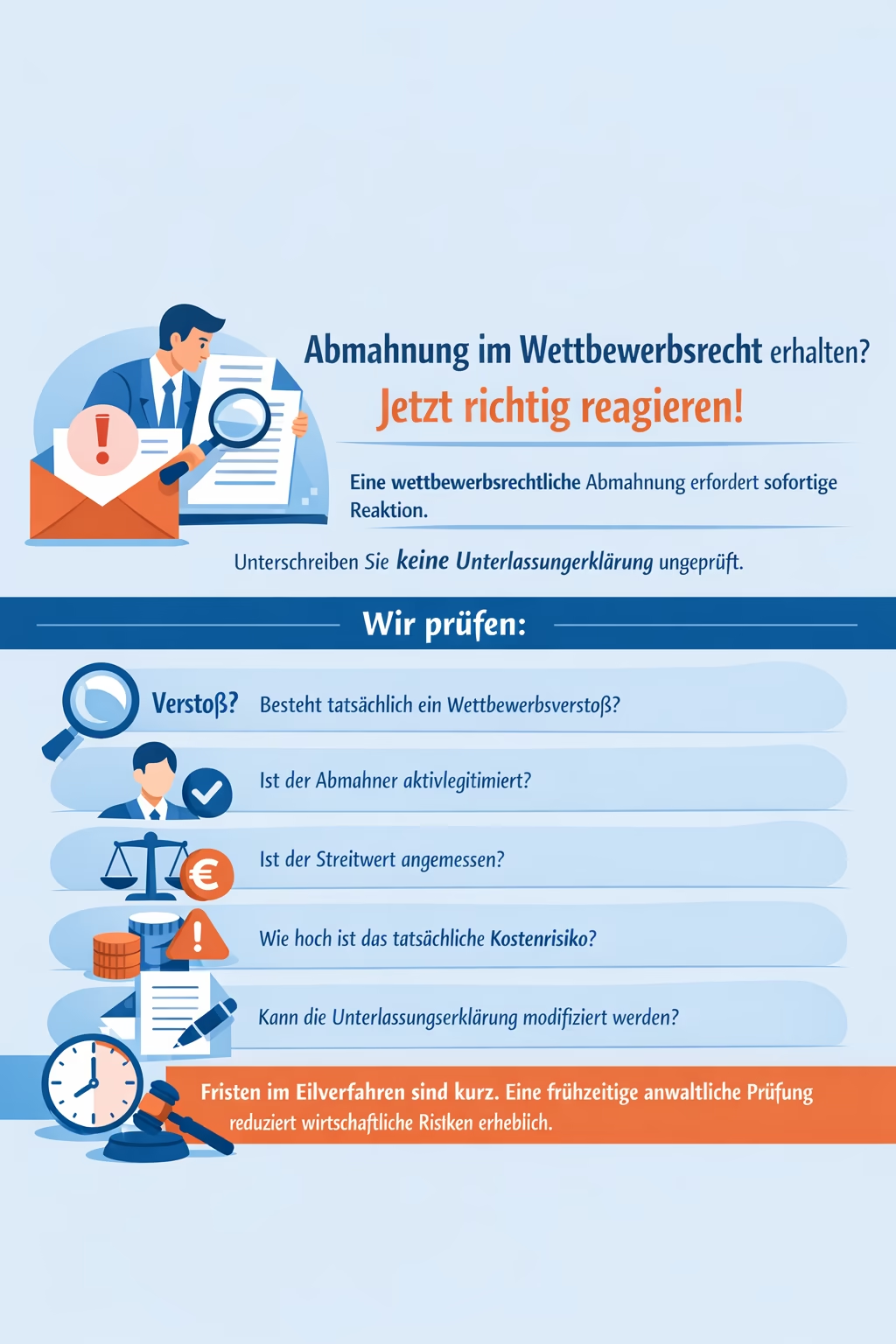
Warning letters in competition law – managing commercial risks early.
Deadlines are short. Contractual penalties are high. Do not sign a cease-and-desist declaration without review – we assess the claim, standing, amount in dispute and cost risk and develop a legally sound defence strategy or go on the attack for you.
Responsible lawyer for competition law at ITMR
Jean Paul P. Bohne, LL.M., MM
Rechtsanwalt (attorney) | Partner | Business mediator
- Fachanwalt für Urheber- und Medienrecht (certified specialist lawyer for copyright and media law)
- Fachanwalt für IT-Recht (certified specialist lawyer for IT law)
- AI Officer | KI-Beauftragter [DEKRA]
- Certified Information Privacy Professional/Europe [CIPP/E]
- Cert. Information Privacy Manager [CIPM]
- External data protection officer [TÜV]
- Data protection officer [TÜV]
- Data protection auditor [TÜV]
- IT Compliance Manager [TÜV]
T: +49 211 737547-70
E: bohne@itmr-legal.de

Emma-Marie Kürsch
Rechtsanwältin (attorney) | employed
T: +49 211 737547-70
E: kuersch@itmr-legal.de

Otto Weidenkeller
Rechtsanwalt (attorney) | employed
T: +49 211 737547-70
E: weidenkeller@itmr-legal.de